
The short answer.
A cheese curd is fresh cheddar cheese, caught early. In a normal cheddar production run, milk is clotted, cut, drained, and salted, and the resulting solids are then pressed into blocks and aged for months. A curd is what you get when the cheesemaker stops at the salting step, bags the solids, and sends them out the door the same day. Same milk, same culture, same rennet, same process — interrupted.
That interruption is the whole product. It is why curds are mild rather than sharp, why they are knobby and irregular rather than smooth, why they squeak, and why freshness matters more for curds than for almost any other cheese you can buy.
What they are made of.
Four ingredients, in most cases. Milk, usually cow's milk from farms within a short drive of the plant. A bacterial culture, which eats lactose and produces lactic acid. Rennet, an enzyme that clots the milk into a solid gel. And salt, added at the end. If the curd is yellow, there is a fifth: annatto, a natural extract from achiote seeds used purely as a coloring.
That's it. A good bag of curds has a four- or five-item ingredient panel, and the shortness of that list is a fair proxy for quality. If you're reading a label with stabilizers and anti-caking agents on it, you are not holding a fresh curd. You are holding something engineered for shelf life. Our glossary breaks down each of these terms in more depth.
How a curd is actually made.
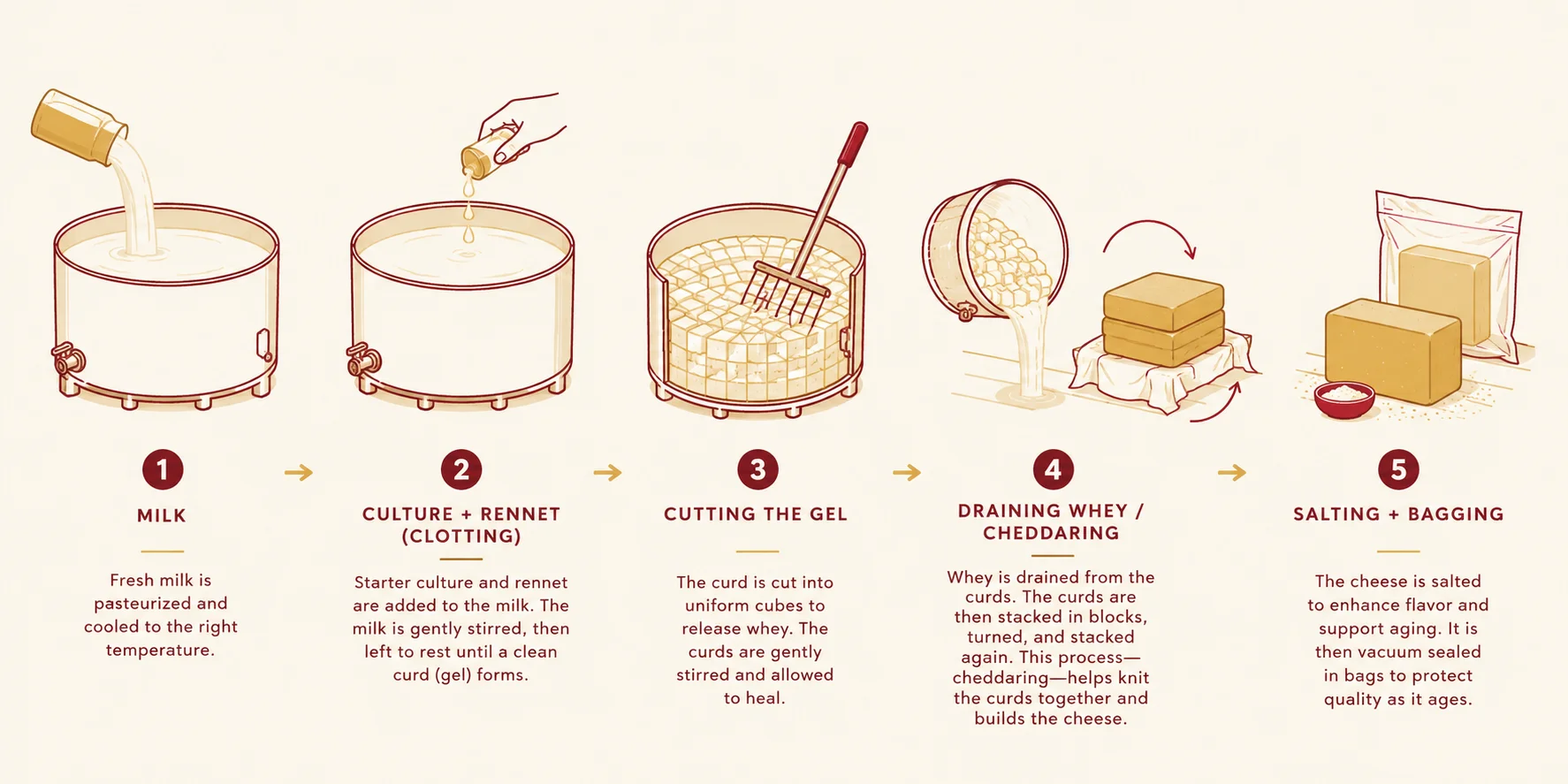
The process runs in a single morning. Milk arrives at the plant and is pasteurized, then warmed in a vat. The culture goes in and begins acidifying the milk. Rennet follows, and within roughly half an hour the milk sets into a soft, custard-like gel.
The cheesemaker cuts that gel into cubes with wire knives, which causes the cubes to weep liquid whey. The whey is drained off. What remains is stacked into slabs, and those slabs are repeatedly turned and re-stacked, pressing more moisture out and knitting the proteins together — this is the step called cheddaring, and it is where cheddar cheese, and therefore the cheese curd, gets its name and its texture.
The knitted slabs are then run through a mill, which tears them into the irregular, thumb-sized chunks you recognize. Those chunks are salted. And here the road forks: press them into forty-pound blocks and put them in a cave, and in sixty days you have cheddar. Bag them and put them on a truck, and you have cheese curds.
What they taste like.
Mild, milky, clean, and lightly salty — like very young cheddar, because that is precisely what they are. There is a fresh lactic tang, a faint sweetness from the milk, and none of the sharpness, crystallization, or funk that months of aging would develop. A curd is not a complex cheese and is not trying to be.
The texture is doing at least half the work. A fresh curd is dense and springy, with a slight rubbery resistance, and it breaks apart in irregular layers rather than slicing cleanly. And then there is the squeak.
A curd is the only cheese that tells you how fresh it is out loud.
Why they squeak.
The casein proteins in a fresh curd form a tight, elastic mesh, held together by calcium. Bite down and that mesh resists — your teeth rub across the protein strands instead of cutting cleanly through them, and the friction produces vibrations in the 1 to 2 kHz range that you hear as a squeak.
It fades fast. As the curd sits, its bacterial culture keeps producing lactic acid, the pH drops, and the falling pH dissolves the calcium holding the mesh together. The structure softens, the friction goes, and the squeak goes with it — typically within 24 to 72 hours of the curd being made. This is why serious curd producers ship same-day, and why a silent curd in a deli case has told you something true about itself. The full science is here →
White curds, yellow curds.
The difference is annatto, a pigment extracted from the seeds of the achiote tree, and it is a color decision rather than a flavor one. Blind-tasted, a white and a yellow curd from the same vat are the same curd. The split tends to be regional and traditional: Wisconsin has historically leaned yellow, Ellsworth and much of the upper Midwest sell a lot of white, and Quebec producers making curds for poutine are overwhelmingly white. Anyone who tells you one color tastes better is telling you about their childhood, not about the cheese.
Curds vs. mozzarella, paneer, and cottage cheese.
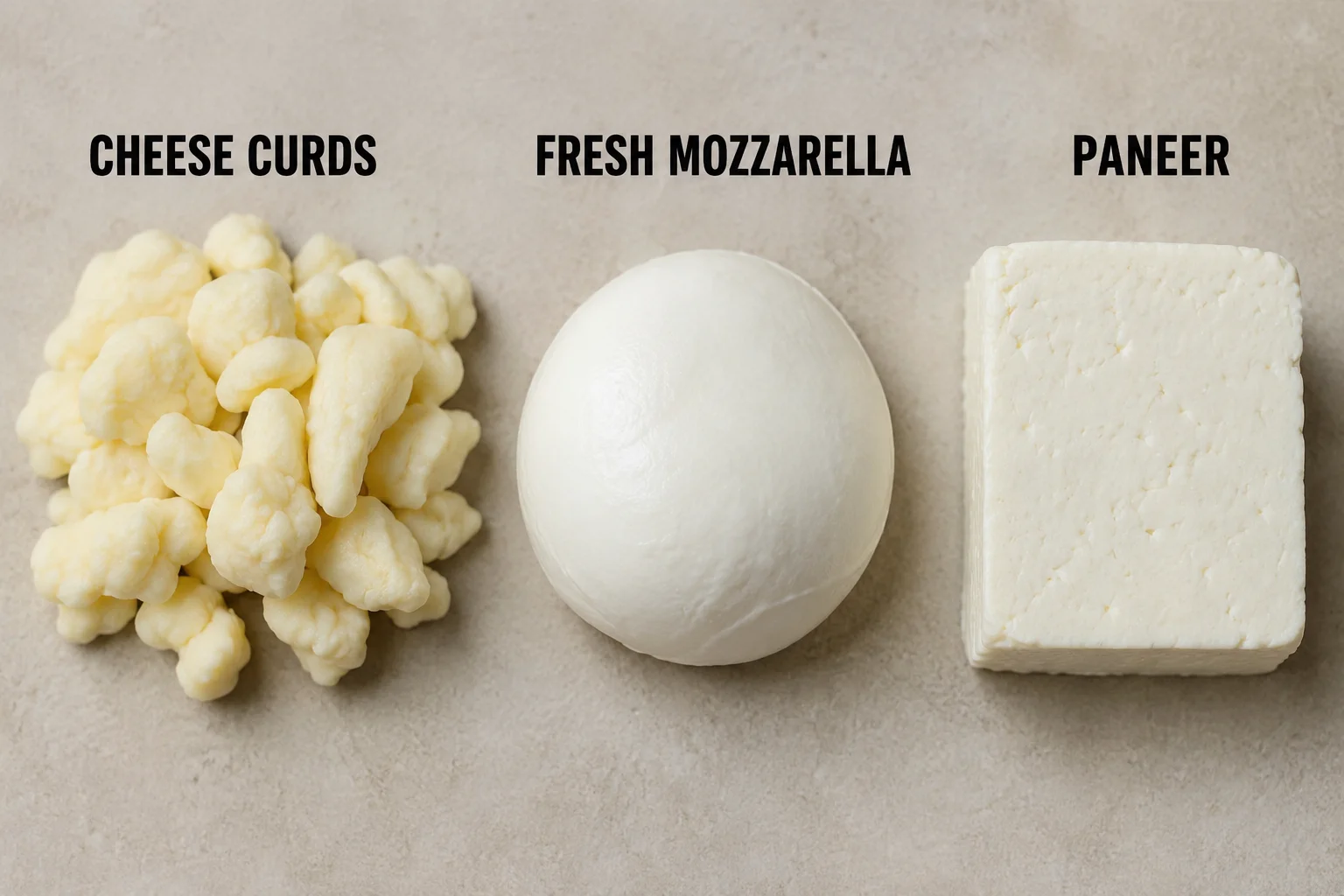
All four are fresh, unaged cheeses, and they get confused constantly. The distinctions are real and they come down to what happens after the milk clots.
Mozzarella is a pasta filata cheese: after clotting, the curd is stretched and kneaded in hot water, which aligns the proteins into smooth, layered sheets. That alignment is why mozzarella pulls into strings when it melts, and why its texture is silky rather than knobby. A cheese curd is never stretched — it is cheddared, which knits proteins together in a dense, disordered tangle instead.
Paneer is acid-set rather than rennet-set, made by curdling hot milk with lemon juice or vinegar and pressing the result. It has no bacterial culture, so it has no tang, and it famously does not melt. Cottage cheese is closest to a curd in origin, but the curds are cut small, washed, and dressed in cream — the wash removes the acidity and the dressing changes everything about the texture. And "curd cheese", a term you will see in British and Indian recipes, is usually a soft fresh cheese closer to quark or paneer, not the squeaky snacking curd this site is about.
Are they good for you?
They are cheese. Specifically, they are cheddar, and they carry cheddar's nutritional profile: roughly 110 calories and about 7 grams of protein per ounce, with the saturated fat and sodium that a whole-milk cheese implies. Curds are also genuinely minimally processed, which is a real point in their favor — a four-ingredient label is rare in a snack food.
None of which makes them a health food. Portion size is the whole conversation, and a bag of fresh curds is engineered by nature to disappear faster than you planned.
How to buy them.
Two rules. First, buy on freshness above everything else — the production date matters more than the brand, the color, or the price. Second, if you cannot get to Wisconsin, buy from a producer who ships fast and cold, because the alternative is a curd that arrives with its squeak already gone.
We test curds on squeak, texture, flavor, and shipping reliability, and publish the scores. Start with our reviews → If you want the short version: the best mail-order curds is the page most people need.