The short answer.
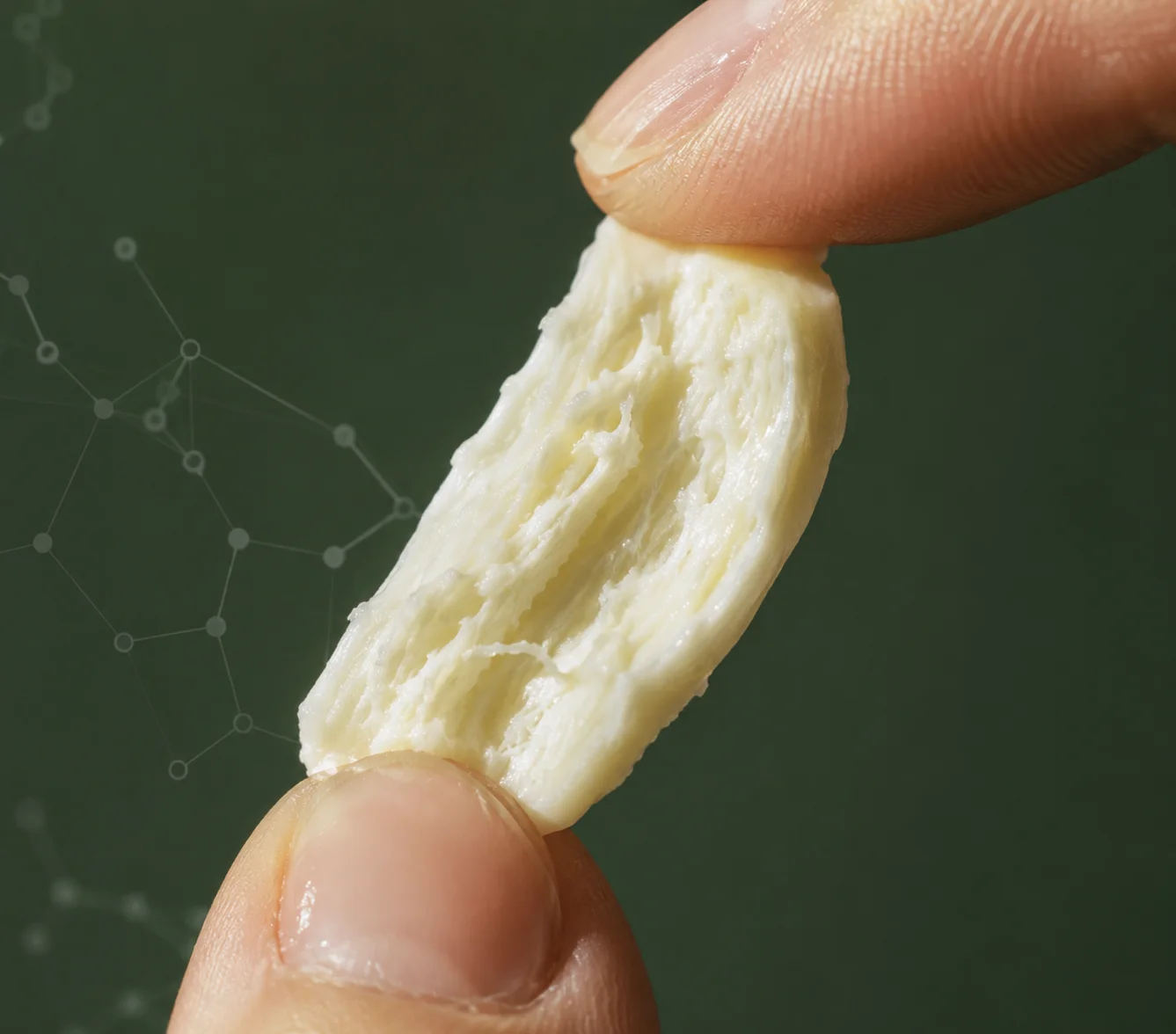
A fresh cheese curd squeaks because of its protein. Specifically, the casein proteins in the cheese form a tight, elastic, rubbery mesh cross-linked by calcium. When you bite down, that mesh resists your teeth and rubs against your enamel, and the friction produces vibrations — roughly 1 to 2 kHz — that you hear as a squeak. As one cheese scientist puts it, your teeth are the bow and the protein strands are the strings.
How the structure forms.
To make curds, milk is warmed and a bacterial culture is added. The bacteria eat lactose (milk sugar) and produce lactic acid. That acid begins cutting the casein protein bunches into shorter pieces, which then reassemble into a long, elastic net. This net traps the milk solids and separates them from the liquid whey. Cheesemakers drain the whey, salt the curds, and — crucially — bag them and ship them fast, because the clock is already running.
The squeak isn't a novelty. It's a precise, audible indicator of freshness. A loud curd is a young curd.
Why the squeak fades.
Two things happen as a curd ages. First, moisture. A fresh curd holds about 80% moisture, and that moisture keeps the protein bundles plump and lubricated — which is part of what lets your teeth glide and squeak across them rather than mush through. Curds lose 10-15% of that moisture within 72 hours. Second, and more important, chemistry: the bacterial culture keeps producing lactic acid, the pH drops, and the dropping pH dissolves the calcium that was holding the protein mesh tight. As the calcium leaves, the structure softens, the friction disappears, and the squeak goes silent. This is why most curds stop squeaking within 24 to 72 hours of being made.
The microwave trick, explained.
The folk wisdom is real: a 3-5 second zap in the microwave can bring a quiet curd's squeak partway back. The brief heat is thought to re-constrict the protein structure, tightening the mesh enough to restore some friction. (The exact mechanism is still debated — hydrophobic interactions within the casein matrix probably play a role.) The key word is brief: heat the curd too long and it simply melts. And there's a hard limit — see below.
The point of no return.
If a curd sits in the fridge for around two months, a different and irreversible process takes over: proteolysis, the enzymatic breakdown of the proteins themselves (the same enzymes used in cheesemaking). Once the protein strands are actually broken apart rather than just loosened, no amount of microwaving will bring the squeak back. The curd is still perfectly edible — it's just become, structurally, young cheese rather than a curd.
How squeak survives shipping.
This is the producer's central challenge: a curd is at peak squeak within 1-3 days, but mail-order takes time. The main answer is freezing. A frozen curd's protein structure is locked in place; it can thaw out in California or Texas and retain its structure — and squeak — for roughly two more weeks. The best mail-order producers also lean on speed and cold-chain engineering: Gardner's, for instance, ships same-day from Wisconsin in destination-calibrated cold-pack, so the curd reaches you while the protein mesh is still tight. See how that holds up in our testing →
The takeaway.
The squeak is the most honest label a cheese curd has. It can't be faked or added; it's a direct readout of how recently the curd was made and how intact its protein structure remains. When you bite a curd and hear that high, clean squeak, you're hearing fresh, calcium-cross-linked casein doing exactly what it does for the first day or two of its life. That's why we score squeak on every review — and why we tell people to eat curds fresh, warm them briefly if needed, and never judge a curd that's been sitting in a deli case for a week.